Category: articles
-
How BuzzFeed built value by designing awesome experiences inside other platforms
In some recent client work, an emerging theme is that consumer tech. / media start-ups no longer control the most important bits of their UI.
Today, if you’re a consumer technology or digital media company, nearly all of your customers will first encounter you through a channel like Facebook, Instagram, twitter, an app store or an email application. In each case:
- You, as the app developer or content owner have minimal control over how your application or content looks and works in these platforms.
This means that you need some very good designers, engineers, and content creators who deeply understand each channel from both a technical and audience perspective. You need to excel within tight constraints, and be able to change your Facebook App or twitter strategy very quickly based on user behavior.
- Most of these channels are controlled by incumbents who set the rules for these channels and can change them at a whim.
This means that you need to grow very quickly, develop your own direct connections with users, and find an early exit strategy that will work.
BuzzFeed excels at both of these. And between all of the stupid top-N lists, and cat videos, they’re also producing some fantastic long-form journalism. So yeah, I like this deal.
- You, as the app developer or content owner have minimal control over how your application or content looks and works in these platforms.
-
Most of Facebook’s valuation is driven by 0.15% of Mobile Gamers
As you read the breathless reviews of Facebook’s Q2 2014 results, remember that the entire App economy depends on a tiny group of whales who spend hundreds of dollars a month on in-App purchases.
This is terrifying.
Facebook’s stock price is the second derivative of in-app purchase revenue. Things are highly geared, and incredibly risky. Which isn’t to say that you can’t keep making money on $FB; just know the risks you’re running.
It’s only a matter of time before Tim Cook makes a move to capture some of the App advertising market for himself.
All that said, well done Facebook!
-
Apple backs down, restores ability to sync contacts & calendar without an iCloud account
Back in October I noticed that, with the release of Mavericks, Apple removed the ability to sync your Contacts and Calendar directly between your Mac and iPhone or iPad. Instead, they forced you to use iCloud, and upload and store your information in iCloud.
I was a bit peeved at this; so were other people. I didn’t think that I should have to share my Contacts with Apple just to move them between two pieces of hardware that I own. Especially since I had never had to do so in the past.
Anyway, in OS X 10.9.3, it looks like Apple restored the ability to sync your Contacts and Calendar directly between your Mac and your iPhone or iPad.
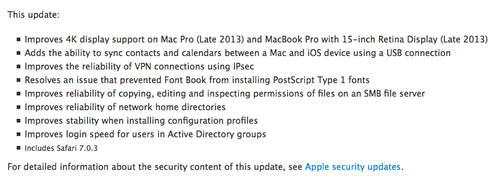
You’re welcome, internet.
-
Peer review
I have just written the world’s worst science research paper: More than incompetent, it’s a mess of plagiarism and meaningless garble.
Now science publishers around the world are clamouring to publish it.
– Tom Spears, Blinded by Scientific Gobbledygook, Ottawa Citizen, April 21, 2014
-
Effectively change the hosts file of your iPhone, iPad or Android with ettercap
Based on “Test web apps on iOS by DNS spoofing your LAN with Ettercap” by Henrique Barosso. Modified to work on a Mac running OS X.
To access a website or service that uses a virtual host but isn’t in DNS, you need to add it to the
hostsfile of the machine you’re using for testing.Unfortunately, you can’t edit the hosts file of a (non-jailbroken) iPhone or iPad. This makes testing difficult.
As a work around, we’re going to use ARP spoofing to intercept DNS requests from your iPhone or iPad and respond to those requests with the IP address of your virtual server.
So, if accessing your development environment requires a
hostsfile entry like192.254.12.1 devserver.mysite.com
then this process will let you tell your iPhone or iPad to resolve
devserver.mysite.comin the same way.A few things to keep in mind before you do this:
- you need to have
sudoon your Mac - your iPhone or iPad and Mac need to be on the same WiFi network, and
- you can do a lot of evil, evil things by ARP spoofing on a public network; do not do this, it’s illegal
With that said, to get this going:
- Install
ettercap. I recommend using homebrew to manage linux ports on your Mac:% brew install ettercap
- Find the IP address of the device (iPhone or iPad) you’d like to test with. On iOS 7 you can see your phone’s IP address by navigating to Settings > Wi-Fi > Wireless Network Name . Let’s say it’s
192.168.1.105. - Turn of WiFi on the device you want to test with; this will clear its ARP cache.
- Edit
/usr/local/etc/ettercap/etter.dnsand add an entry for the virtual server you would like to test, e.g.# Websites for testing devserver.mysite.com A 192.254.12.1
- Enable the firewall and IP forwarding:
% sudo sysctl -w net.inet.ip.forwarding=1 % sudo sysctl -w net.inet.ip.fw.enable=1 - Start
ettercapand activate thedns_spoofplugin:% sudo ettercap -i en1 -T -q -M ARP:remote -P dns_spoof /192.168.1.105/ //
Remember to replace
192.168.1.105with the IP address of your phone or tablet. - Turn WiFi back on on your device.
If everything worked properly, you should see some output from ettercap, letting you know that it’s intercepted an ARP request on your device.
% sudo ettercap -i en1 -T -q -M ARP:remote -P dns_spoof /192.168.1.101/ //
Password:

ettercap 0.8.0 copyright 2001-2013 Ettercap Development Team

Listening on:
   en1 -> XX:XX:XX...

SSL dissection needs a valid 'redir_command_on' script in the etter.conf file
Privileges dropped to UID 65534 GID 65534...

  33 plugins
  42 protocol dissectors
  57 ports monitored
16074 mac vendor fingerprint
1766 tcp OS fingerprint
2182 known services

Randomizing 255 hosts for scanning...
Scanning the whole netmask for 255 hosts...
* |==================================================>| 100.00 %

Scanning for merged targets (1 hosts)...

* |==================================================>| 100.00 %

7 hosts added to the hosts list...

ARP poisoning victims:

 GROUP 1 : 192.168.1.101 CC:XX:XX:XX:XX

 GROUP 2 : ANY (all the hosts in the list)
Starting Unified sniffing...


Text only Interface activated...
Hit 'h' for inline help

Activating dns_spoof plugin...

dns_spoof: [devserver.mysite.com] spoofed to [192.254.12.1]
- Try navigating to
devserver.mysite.comon your device. If it doesn’t work, then try turning your WiFi on and off again to flush the ARP cache. - Once you’re done testing, press
qto exit ettercap.
That’s it! If you have questions, concerns, or enhancement suggestions please let me know on twitter (@josephby) or join the conversation on Hacker News.
- you need to have
-
10 Ways to Create a Billion Dollar Media Brand
- Write snappy headlines that include no information. Link those headlines to a four-hundred word article which, if properly edited, would be two sentences long.
- Make people who try to read your website on a mobile phone dismiss a request to install your App. Every. Damn. Time.
- Include multiple, paid links beside every article. Do not label them as “paid”. Better yet, apply a misleading label like “Articles Recommended for You.”
- Write lots of top-N lists and implement them with slide shows.
- Hijack the “Copy” function of the web browser so that anyone who tries to quote a single line of the article will paste in twenty lines of garbage.
- Share buttons. Everywhere!
- “Syndicate” your posts so that “marketers” can re-use them in their “content marketing” efforts.
- Create articles that consist of nothing but twitter conversations and snappy commentary. Report on said conversations as though they were news.
- Be outrageous. Failing that, be outraged. Failing that, be snarky.
- Ensure good search engine placement by making the URL of each article more/informative-than-the-headline-or-body.
-
Is the open internet dead?
I was fortunate enough to get online in the mid-90’s. I wrote some terrible software to configure Dial Up Networking in Windows 3.1, and then sold it to a local ISP for years of free access.
At that point, consumers were rapidly adopting what I’ll call “open” technologies, including email, forums (USENET), messaging (IRC) and file transfer (ftp). The web was about to be littered with millions of consumer home pages, hosted by Geocities and people’s internet service providers.
Since then, nearly all consumer technology growth has moved from open to closed systems. Facebook and Google are “closed” in the sense that those companies exert total control of the platform, in a winner-take-most marketplace.
It’s hard to find recent examples of new, open technologies that had a lot of direct consumer adoption. The few I could think of are:
- Firefox (which went mainstream in the U.S. around 2004)
- Bittorrent (2005)
- RSS (2005)
- SMS (2008)
- open video formats (2010, when YouTube added support)
Of these, I’d argue that only open video is thriving. Of the rest:
- Firefox is suffering under pressure from Chrome
- Bittorrent is being replaced by Netflix, Spotify and Hulu
- RSS has been all but abandoned, replaced by twitter and weibo
- SMS is under heavy attack by closed platforms like WhatsApp and Skype
Today, the fastest-growing platforms are all closed and controlled by large corporations.
Very few start-ups go public. This means that if you’re a successful new company, built on an open platform, you’re likely to be acquired by one of the incumbents and merged into their closed platform.
Is it still possible for open to win? Or is it time to give up, and search for a political solution?
.svg)